Ghost-Eye
Pustak Padho Reviews [Translation - Read a Book]
If you were expecting a review of Mother Mary Comes to Me or Heart the Lover, I apologise, my April tiebreaker resulted in choosing a different book entirely. Heart the Lover is next, for May.
I didn’t particularly intend to read Ghost-Eye, never having read any Amitav Ghosh, but it was the book of the month on a new virtual book club I joined. I thought it was a good opportunity for me to read more Indian authors, and so I bought the hardback, at full price, and gave it a go.
I was travelling when the book club discussions happened, so I did not have the outlet I needed for my feelings on this book. And so I must distil them here.
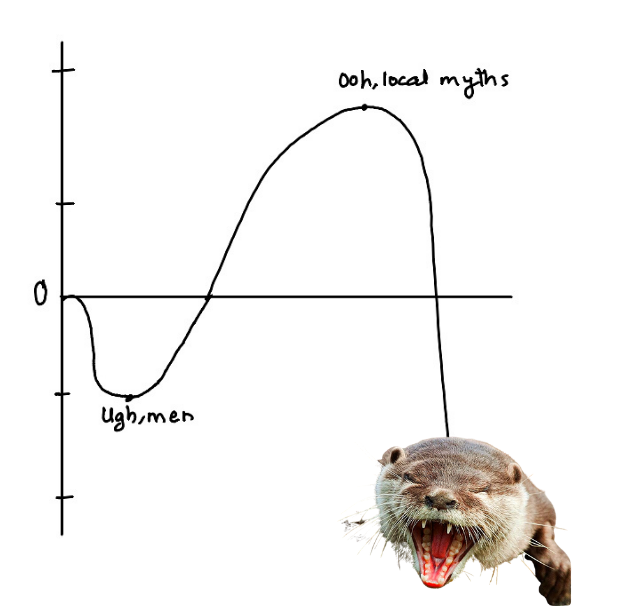
I spent the last few years of my fiction-reading primarily with women. It started with white women, then, realising my shelf was too white, I read Black and Latin American women, and then, realising I needed something with reference to culture I could relate to, I read Indian women. I read sci-fi, fantasy, literary fiction, magical realism, and a bit of romance. What I didn’t read for the longest time was a man. I forgot why, until I read Ghost-Eye.
I started quite irritated with the writing. Perhaps because I was coming off a lot of literary fiction, my thirst for luscious sentences dripping with meaning was left slightly unquenched. Not that the writing was bad at all, it was simply, well, simple. I reminded myself this was a me-problem and continued, until I had to keep the book aside for a few days when the protagonist (Dinu, a man) described his mother as “large-bosomed” when the other descriptors of “plump” and “flaunt(ing) the markers of conservative Bengali matronhood” would have sufficed to paint an accurate picture. A parallel in Zadie Smith’s On Beauty, where the protagonist’s mother “lifted her glasses from where they rested on a chain upon her impressive chest”, doesn’t feel as obnoxious in the third person, along with the ungendered ‘chest’. It works as a descriptor, not an opinion with an icky Oedipal essence sprinkled upon it.
I urged myself to pick up the book again–it was for the book club, I spent Rs. 800 on it, and the premise itself was interesting. For some context, the story starts with a toddler in a strict Marwari Brahmin family in Calcutta (it seems no Bengali author writes about any other city). But again, my saltiness has nothing to do with this book, but with the fact that I ended up reading too many books in quick succession that were either vivid descriptions of the Tollygunge Club, or Communism (more on this in the post-script).
Back to the toddler– one day, out of the blue, young Varsha refuses to eat anything until she is fed fish curry, never having tasted fish before. It seems she is remembering a past life where she was a fisherwoman in the mangrove forests of the Sundarbans. Dinu is introduced as the nephew/adoptive son of Shoma, the psychiatrist summoned to assist Varsha’s distraught family, aghast by the prospect of their upper-caste child asking for meat. As Shoma delves deeper into Varsha’s history, we begin to realise that it is not only the past she can see, but glimpses of the future as well.
We don’t linearly get the information, since Ghosh employs, to great effect, alternating timeline-and-perspective shifts. We swap between 1960s Calcutta in third-person omniscient and 2020s New York in first-person reminiscent. The voice shifts are done very smoothly – sometimes it is only at the end of the sentence that you realise we are now in first person with the chapter change.
The plot unfurls through letters written by Dinu to a young nephew of sorts, Tipu, whose connection was explained but wasn’t important, so I've already forgotten it. What I haven’t forgotten, though, is the pain of reading a Boomer author write Gen Z slang. “Okay, Pops, since you’re trippin’ on me, I’ll spill the tea.” Or “the ghost-eye way is all ‘bout what’s right here, ‘bout bein’ from the soil–” and “Pops, these are all in cursive. I’m a screenager–”. I am not saying they are terribly inaccurate. But they are terribly uninteresting to read and come off as gimmicks rather than a representation of how the character speaks.
Still, we continue through the story, which is well-researched, weaving local legends and mythology with modern fiction in a magic-realism way, reminiscent of Isabelle Allende. We discover that there exist many ghost-eyes like Varsha, people who have this connection to our world beyond the present reality, and they are uniting for a climate fiction, save-the-world side quest that somehow, we don’t care very much about.
Perhaps we are not supposed to, because Tipu’s storyline is always kept at an arm’s length, delivered to us over quick phone calls in the Gen Z caricature speak. So, when the plot comes to a head, the reader’s reaction is ambivalent in a ‘good for them’ sort of way. We are made to care more about Dinu, and when his storyline resolves in a twist, it feels like a cheap exit rather than the depth his character deserved.
Spoilers sit within these next few lines, so skip this if you intend to read the book. My summary and recommendations come after.

Even Dinu himself doesn’t play an on-the-ground role in the climate subplot, because through his involvement in finding Varsha and convincing her to help, he is also discovering new things about his own past.
There are bits of obvious foreshadowing, like when Dinu has a face-off with a giant fish in a tank that gets so agitated it flips its own tank over. We uncover hints that Dinu himself had exhibited some strange behaviours in his childhood, but rather than visions or premonitions, he mostly had seizures.
The last 20-or-so pages wind up the climate crisis successfully, and we sit with Dinu as he uncovers the whole truth about himself in an expositional letter from his aunt to a colleague. We discover that Dinu and Varsha were connected in their past life, a special bond between them via the fishing village they lived in. Their love remained unrequited as past-life-Dinu died before past-life-Varsha, but also because of the small matter of bestiality, since Dinu used to be an otter. An otter. One that was trained to hunt fish. By the fisher-people in the village, of which Varsha was one. That is why the fish-tank-catfish got agitated; it saw its predator. I was made to care for 300 pages about this storyline, only to be told the main character is an otter. If the author (otter???) was from any other (otter??) state apart from Bengal, you would call this stereotyping – he eats fish and has a spooky connection with them, so he must have been an otter? I stayed up past my bedtime to finish this book and was rewarded with the equivalent of ‘he woke up and realised it was all a dream’. Husband came to bed to find me laughing at the page in disbelief and with a crazed look in my eye at this literary betrayal.

If your question is, “Should I read this book?”, I cannot answer it with a yes or no. It was an engaging piece of fiction, and if you prefer reading clean, simple prose with a detailed plot, you might enjoy it very much. But if you are the kind of person who likes to deeply engage with a character, and tends to join them on their journey, then this book’s treachery is significant enough for me to protect your interests are recommend you stay away.
Short version:
Meanwhile, a little note on the other books I mentioned here
On Beauty – Zadie Smith
This is the first novel of Zadie Smith’s that I am reading. I’m only a fifth of the way through, but I like it so far. It is seeming like a nice family-dramedy sort of read, strangely reminding me of Crazy In Love, the Steve Carell–Ryan Gosling family subplot section at least.
The Lowlands – Jhumpa Lahiri
I love how she writes, so I enjoyed reading this. It was the first of the Calcutta-Naxal stories I read, so it felt fresh then, educative even. It is a family drama spanning decades, exploring the changing trajectories of life between two brothers from the lowlands of Calcutta.
Before We Visit the Goddess – Chitra Banerjee Divakaruni
I had only read her Mahabharata and Ramayana rewrites and enjoyed both, especially the Forest of Enchantments as a woman’s perspective on everything that happened to Sita. So when I read the overleaf summary about an interwoven story of three generations of women, I picked it up very quickly. It gave me Ann Patchett but desi version – it did not disappoint, the plot was tight, and the characters felt whole – you could find bits of yourself in each of the characters without any of them having a Mary Sue problem.
Our Friends in Good Houses – Rahul Pandita
Not related to Calcutta, this one, but to the Naxal movement in great detail. It is a novel about a war reporter and his lifelong search for the feeling of home as a displaced Kashmiri Pandit. Sounds good. And it is written by a Kashmiri Pandit war journalist, which I think is its problem. It is a novel, but it seems to draw very directly from the author’s life, in a way that it includes stories that the reader is not interested in, but obviously were impactful in the author’s life. I found it very difficult to read because I didn’t care about the six different failed relationships he had – you can only make the reader care once. It did teach me a lot about discerning good fiction from, well, not good fiction – and if (when) I write something myself, I have a whole list of things I shouldn’t do.
And if you missed it, the March book review is here:

I meant Crazy Stupid Love… not the Beyoncé song - ha